Regional Spotlight Artist Profile | Larissa Dubrowski
Published on 01 October 2026
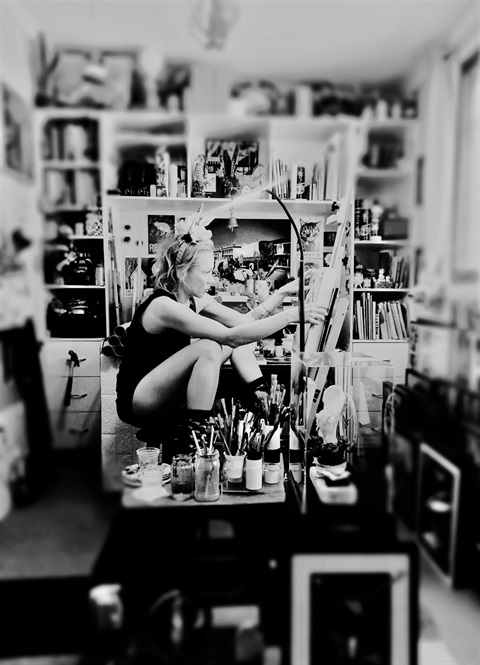
The Regional Spotlight initiative is an opportunity for Wide-Bay Burnett artists at any stage in their career, working in any visual art medium, to receive mentorship and share their work at the gallery. Developed from an expressions of interest process, the 2026 exhibition brings a multifaceted survey of local artists sharing their personal connection to space, landscape, environment, home and time through mediums of painting, photography, printmaking, sculpture and mixed media work.
Assemblage artist Larissa Dubrowski recontextualises the environment by utilising repurposed materials that are often overlooked.
How long have you been making artwork?
I have been making art for about 30 years, although it was four years ago that I dedicated myself to my practice and working towards making it my profession. My creative practice began in Tasmania during the nineties, where I experimented with large-scale oils and acrylics on board. Drawing from expressionism and abstract expressionism, these early works laid the foundation for a parallel exploration into mixed media assemblage sculpture.
One of the first pieces I created (in my early teens) was called ‘Citadel- fortress of the mind’. I melded together an old flue, a broken laptop, and wire to represent how I felt our reliance on technology was unsettling our minds… My goodness, look at us all 30 years later!
What are your favourite mediums to work with and why?
Goodness—because so much of my sculptural work utilises repurposed, reclaimed, and industrial materials, that is a bit of a Pandora’s box question! I definitely love old, rusty steel pieces; I love the material as it is found, and I love when you clean it back to reveal sparkling possibilities.
I love wood because it often smells delicious and usually looks amazing without even needing to touch it—though with a light sand and a little oil, it’s completely transformed. I love concrete because it keeps me on my toes, makes me sweat, and I can soften its hardness with a coat of paint.
I love plaster because I can mould it, and its fragility makes its form feel sensitive.
I love wire—old fencing wire, copper wire, thin gauge, thick gauge— because even though it’s malleable, it will hold its shape. And I love clay! Clay is an underrated conduit that allows me to marry ‘incompatible’ materials almost seamlessly. And when it comes to painting nowadays—quality acrylics! I love the ease, the quick dry time, the non-odorous application, the versatility, and the gorgeous lustre."
Who/what inspires or influences you?
There is definitely no shortage of inspiration and inspiring people! I am inspired by materials, form, smells, and touch. I love our landscape and the bush—the changes in light during the day, the crispiness of the drying bush, the trees bursting bark.
I am deeply moved by the sheer being of our environment and the gifts I can forage from it. Conceptually, I am inspired by artists like Denise Green and Paul Klee, and their rejection of literal realism in favour of a symbolic, interior reality: art helps us to see, it’s not reproducing what we see. I am also incredibly inspired by all my teachers but particularly my generous art teachers. Jane, for her compassion, encouragement to experiment, and for introducing me to the works of Davida Allen and Geoff Dyer.
When I saw Dyer's West Coast Cutting at the Plimsoll Gallery in 2003, it completely changed the course of my practice! It was enormous, and it had cigarette butts and sand embedded right into it and showed landscape in an entirely new light. And Carmen, for her mentorship, for believing in me, and for introducing me to the works of Max Ernst and James Gleeson.
Has your practise and subject matter changed over time? If so, how?
My sculptural practice has not fundamentally changed, but it has certainly evolved and become more refined. Through the experience gained using different materials (lots of trial and error) and developing skills in framing and welding, I have been able to significantly elevate my work.
I work a lot with themes around adaptability, interconnectedness, resilience, and sustainability. These are usually reflected in the materials and compositions, using the environment as a stage to mirror our human qualities.
I moved away from oils about 15 years ago, and when I stopped using them, I also stopped painting abstract and expressionist portraits (much to the delight of my family, he-he!). My current acrylic and mixed-media work blends representational and abstract forms to explore the infinite detail and textural marvel of the Australian bush and my personal connection to it.
I love working with micro and macro interpretations; the super-fine brushstrokes and intricate detail are almost a therapy for me. Conversely, 25 years ago, I used heavy textures, bold brushstrokes and paint that oozed off the board—which, living in Tassie, took lifetimes to dry!
What do you most like about living in the region?
What I like most is that I feel completely at home here; I cannot say that I have ever really experienced this sense of homeliness anywhere else. Although I realise the question relates more to the broader region, it’s difficult for me to look past my acreage, which often feels like its own island paradise.
Spotted gums, ironbark, lantana! A dam that sometimes holds water and sometimes not; a home that sometimes leaks and sometimes not. Living here fulfils most things for me and the cat—and my imagination does the rest.
What advice would you give your younger self?
Oh! I don’t think I would give advice to my younger self – younger me would likely not have been open to it unless younger me respected older me. Perhaps I ought to get advice from younger me?! I was more switched on, less fearful and far more articulate then. Indeed, regression!
Is there anything else you would like to add?
I am very grateful for all the things that have played out in my life in the perfectly imperfect intricate design that has unveiled myself and led me right here.
What is the most interesting feedback you have had about your work?
I have found the most interesting feedback relates directly to a person's emotional experience, rather than a critique of technique or simple aesthetic pleasure. Intriguingly, the feedback I receive from everyday viewers, as opposed to the traditional art-world audience, is more often rooted in a deep sense of personal connection and reflection. I recently had a viewer share this beautiful sentiment with me:
“Your work feels like a poem written by time itself. This feels like an altar to resilience. Every worn surface carries a story, every crack holds light. It reminds me that the most beautiful things aren’t untouched—they’re shaped by time, loss, and the quiet courage to remain.” — Emily (2026)
Photo: Larissa Dubrowski, supplied by the artist.